Sunday, 27 March 2011

Saturday Shoot

My first thought when I heard we had class on a SATURDAY was “nooooooooooo”. Anyway, luckily I was pleasantly surprised by the day and it turned out to be a lot of fun. We firstly helped out Gabby’s group which, whose idea was simple yet brilliant as it ran so smoothly. Incorporating the bee was a great idea, and at the end of their film the bee ended up chasing me so I’m sure I am going to look hilarious trying to bat it away and look scared... Acting is not my forte, but all the same, it was fun to be in front of the camera for a change!
On the way back from their shoot, our group gathered up some gorgeous petals that had dropped to the ground to include in our shoot which was based around a picnic. We took some inspiration from Andy Goldsworthy through the use of a set up of pine cones and petals around the picnic. We were ahead of time at this point which meant we had plenty of time to set up and organise ourselves. I felt we worked very well as a team together and had a lot of fun rehearsing eating our picnic! We got a few interesting looks from passers-by, and whilst we were rehearsing, three of my roommates happened to walk by... I think they are even more baffled by my Film degree than they were before, but I also think they are a little bit jealous! Whilst we were filming SOMEONE managed to somehow throw Emma’s phone in the river, which provided some extra entertainment for us all! I think she has now put it in some rice in an attempt to salvage it...
Obviously the footage in is black and white, which doesn’t show just how vibrant the set up was – a red and white checked picnic cloth, pink flower petals, red flowers, different coloured tea cups and saucers, a neon green parasol and so on. We took a few colour photos on Emma’s digital camera because it did look really cool.
Drying the film was hilarious. We did a few laps inside Kenan, before going outside to run around the courtyard whilst Barrett filmed us with the remaining film on the regular eight camera. It was a great idea to get some behind the scenes footage to remember the day by – if I had to do this activity every Saturday I would be happy, it really was so fun! I was also extremely hungover (my bad) so I’m glad we had this on as it made me forget to feel sorry for myself quite as much as I would have otherwise!  Great, great day and luckily our footage came out! From the first viewing everything looked pretty good. J

Monday, 21 March 2011

48 Hour Video Race

Ok - I have to admit, I only got back from Mexico last night, and I’m definitely still in spring break mode today... inspiration is sort of lacking. But I shall still make an attempt at this post!
Reading Emma’s post about documenting life as an exchange student is a really good idea... (dammit, why didn’t I think of that first?!) But I really liked the part about the interactive media such as Skype and email and could perhaps incorporate that into a story of my own.
When I first read the guidelines, my initial reaction was to use a cell phone as part of the film. If you think about it, cell phones really do construct our daily lives and we rely on them. As I mentioned earlier, I was in Mexico last week and once we arrived, we realised that none of our American phones worked, except mine which was absolutely no use because I couldn’t contact my friends if we got split up at any point (there were seven of us) which is not very good when you are in a place like Mexico. Cell phones can be used to arrange to meet friends or family, to look up something on the internet, to take photos or videos, to make a call to a friend and so on. The list goes on forever and is expanding all the time. However, the most important thing about a cell phone is that it makes you feel safe. You can get in touch with the police instantly, wherever you are (except in Mexico!) or if you’re out with friends and you get lost you can arrange to meet them again. They are vital to our everyday lives and therefore it feels as though using one for the 48 hour video race to perhaps document someone’s day would be a relevant idea for this film in the 21st century.
It would be cool if we were allowed to scan in photos already taken to go along with any text or voice recording from the cell phone, as it would explain the narrative further and give it more depth. As I’m writing I have come up with an idea but it literally just came into my head... I could document my spring break holiday through photos already taken and excerpts from the diary I kept. It would also be good to use cameraless filming and paint sunsets or bright blues onto filmstrips to represent the sun and sea which could be used as backgrounds. If I did use this idea, the cell phone part may then become irrelevant but I could still perhaps incorporate it somehow. I’m not sure; my brain is still fuzzy... But the more you think about it the more ideas you get! So I shall keep my thinking hat on.

Saturday, 5 March 2011

Experimenting

Camera less filmmaking was most definitely an exciting project. The first aspect I enjoyed was the fact that we collaborated on the project. I felt that helped to bring out each other’s creativity. It meant we could combine our different ideas to produce the best filmstrip possible. It was interesting to listen to Emma’s suggestions and experiment with them, because really, this exercise was an experiment. We had no idea what our film would look like on the projector. I had images of what I hoped it to look like but it was hard to judge, especially as far as timing goes. The first section of our film was the bleached filmstrip which represented air and was meant to look as though the film was breathing. I feel this was one of the most successful parts of the film, and a great opening sequence. It really set the scene. We found that the magazine transfers which looked great before putting them onto the projector, hadn’t turned out as well on the big screen. They appeared grainy and it was very hard to make out the images of butterflies and fruit which was a part of the film we really liked when putting it all together. For our fire section, we combined lots of fiery colours before leading into smoke. I felt quite proud of this section and I thought the sandpaper we used to scratch the film to create the image of smoke was very effective.
An Alchemical Christmas Carol: I enjoyed the fast paced feel of this film. The soundtrack matched up nicely to the quick movement on screen. It was nice to see the scratching at the beginning, as this reminded me of Emma’s and my film. It is a very effective technique, especially against the vibrant colours which the makers combined it with. My view has changed dramatically about this type of filmmaking since the start of this class, because before I had never really heard of it! When my friends see me working on projects for class they are fascinated and are jealous – I would be too, it is so much fun to be given the freedom to experiment this way and produce such interesting results. I remember watching Passage on the first day and being completely baffled by it. I did not understand it, or particularly like it, but I feel that if I were to watch it now with all this experience under my belt, my view of it would change radically. I have learnt to enjoy and appreciate camera less filmmaking.

Monday, 28 February 2011

Sound - Titanic, Inception and The Oscars

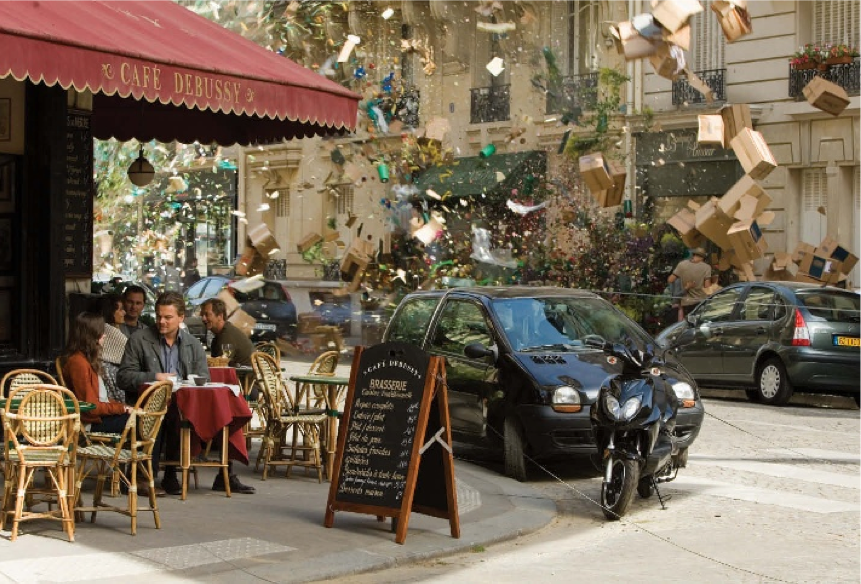
I never really appreciated how much of an impact sound has to our daily lives. When I’ve considered which sense I find to be most important to humans, I always go back to sight. For example, what is the point in listening to a movie if you cannot see it? Wouldn’t you rather see the images? Reading the Cummings article and also through watching the Oscars last night, I realised how significant sound is to a movie and to our daily lives. My friend and I had put bets on who we thought would win each category and I bet that 'Inception' would win Best Sound Mixing and Sound Editing. The film won in both categories and although I have only seen 'Inception' once, I do remember how prominent the sound was throughout, especially in the dream sequences. However, I also remember how awesome the explosions were outside the cafe when Leo DiCaprio and Ellen Page are sitting outside a cafe. I think the two go hand in hand and this article reinforced the fact that sound is just as important as any other sense we have.

The concept of sound walking seems very interesting to me. I sat in my room and tried just to listen for a minute or two. The most prominent sound was the whirring of my laptop, and occasionally I could hear someone talking, noises from upstairs or a car driving past outside. This didn’t necessary lead me to hear that place differently, as the article suggests but it did make me realise that there are a lot more sounds going on around me than I realised and that I must block out an awful lot subconsciously.

With Chion, I agree that sound enriches a given image. If you think about a film such a 'Titanic', it would be nothing without the wailing of ‘My Heart Will Go On’ throughout the movie. It makes the movie what it is – a classic melodramatic love story. Again referring back to the Oscars from last night, they mentioned Titanic and the importance of its music. Thirteen years on it is still being recognised for the wonderful combination of aesthetically pleasing images and sound. Titanic also reflects what Chion describes as empathetic music – the sound in the film allows the audience to feel the love and freedom Rose feels when she is around Jack, and at the same time it permits us to feel Rose’s heartache and desperation towards the end of the movie. Therefore, both these readings have proved that sound is indeed a significant part to any movie or any day of our lives.

Thursday, 17 February 2011

Wells & Animation


Animation: “The act, process, or result of imparting life, interest, spirit, motion, or activity.”
I’ve always been fascinated by animation – to be honest I’ve never really taken the time to fully understand it. Wells mentions Disney several times during his text and it forced me to realise that I have watched these Disney films all my life and have never really appreciated the amount of work which had gone into creating them. I took it all for granted, especially as a child... I guess I am going to find out for myself how extensive the animation process is on Monday!
Wells cites William Moritz in his text, and he elaborates on the effect experimental art has on the audience; i.e. the fact that different meanings can be interpreted from it depending on how abstract something is. I completely agree with this statement and agree with the fact that it is more interesting to have several interpretations of art which can then be discussed. A good example would be ‘Passage’.  Moritz speaks of animation having to encompass “intriguing spirit” and immediately, ‘Western Spaghetti’ popped into my head. I was SO impressed by this film and I think my favourite part was when they chopped up the Rubik’s cube, it looked brilliant. Although it was most definitely an experimental film, I’m not sure a multitude of meanings could be taken from it – I think it was just one of those ‘simple but genius’ pieces of art and it definitely has spirit.
Wells obviously wrote this text in 1998 and I think it’s interesting that he talks about the fact that orthodox animation is 2D as clearly that statement is now outdated. Many Disney films, such as Toy Story 3 are now being made in 3D. I like the fact that  animation is moving forward and it makes me very curious to think what could be being created/invented in a mere 50 years. Thinking of the last 10 years, 3D animation has exploded onto our cinema screens (quite literally) notably in the form of ‘Avatar’. Yes, the narrative was unoriginal, but the animation was spectacular to look at and this brings us back to what Wells discusses in orthodox narrative form – the narrative most often follows a simple ‘chase’ story of some sort and there will be a resolution at the end. I don’t think people get bored of hearing the same story over and over again, as long as they have something new to look at. Image is one of the most important parts of watching a film to me, so ‘Avatar’ was refreshing in that sense.
Animation still baffles me, but it sure does look good.

Saturday, 12 February 2011

Camera less filmmaking...

So this is the first really creative class I have taken since I was probably 16 years old (the most recent one being darkroom photography which I adored). When I found out that this class ran until 9pm, I was slightly worried just because I knew if we were going to be reading or discussing theories then I would zone out at roughly 7:30pm as my brain does just tend to switch off from studying at that point! It therefore came as a relief when I realised what the class actually entailed. I come to class every week excited about what we will be doing that day, as most things we have created so far are novel to me and it’s fun to let myself be free and creative.
My favourite week so far was most definitely creating the magazine transfers. I am a very organised person and I know how abstract the ideas are in 6x1, but I still can’t help but to organise my thoughts and whatever I construct must have some sort of linear quality to it. For this project, I used the wedding magazine and cut out meaningful words and pictures to go together and give an overall sense of a ‘wedding day’. Being given the opportunity to do this makes me realise that I can be creative and artistic, I just never really let myself go there day to day. It’s very inspirational.
6x1 has opened up a whole new world to me; one that I didn’t even know existed. I may be naive but I had never thought about camera less filmmaking until this semester. To be able to see the work that you have created through the projector is pretty cool and it feels much more personal than if you had used a camera to make a film. I mean, who knew that scratching a piece of film with pins and sandpaper could produce such interesting and unique results? Not me!  It is a completely different experience. Even though this class is not typically ‘academic’ in the fact that it we are not necessarily studying an academic’s work and writing long papers, I feel as though I have learnt just as much, if not more in this class than in any of my others this semester. Not only that, but it is a refreshing way to learn. It is great to get away from the books and the theories from a while.

Monday, 7 February 2011

Synesthesia and Cymatics

Synesthesia means to use multiple senses to create a piece of art. The concept reminds me of the idea that a song or a band can remind you of a person, whether it be for a good or bad reason. Only with this the music can be associated with colours. I don’t think I am lucky enough to have experienced this collaboration of the senses, but the idea that Carol Steen could close her eyes during acupuncture and see a vision is quite a ‘far out’ thought to me. It must be a pretty exciting thing to experience. The most impressive example on the Wikipedia page to me was Ana Salz. She painted something which matched up to the music she listened to. It’s so hard to believe that by just looking at a painting, someone can be reminded of a song. If I hear a song, it can remind me of a film, a specific time in my life or, as I mentioned before, a person, however I don’t think I could be reminded of a song just by looking at a painting. Although I wish that was the case!

I guess that colours are often associated with emotions, for example red could be a symbol of passion or romance. Therefore, that concept could be discussed further and if you were listening to a love song, you may see the colour red. This could also apply to yellow with happiness or blue with sadness. For example, when I see the colour yellow, I am forced to associate it with summer, sunshine and happy times which I could then further associate with Reading Festival in England which I attended last summer.
Cymatics is the process of visualising sound. That’s a pretty cool thing to be able to do if you think about it. The fact that scientists are now trying to depict what dolphins are saying through cymatics when they makes noise is crazy, and feels very advanced, but an exciting thought all the same. The film ‘Passage’ which we watched last week contained cymatics, in that that images moved and contracted as the sound changed frequency or pitch. This is a random thought, but talking about cymatics reminds me of the part in the film ‘A Walk to Remember’, when Landon says, “love is like the wind, I can’t see it but I can feel it.” That quote has always stuck with me for some reason, but it’s interesting that now with cymatics it could be possible to be able to actually see the wind and therefore that whole quote could now be meaningless. But I’m a romantic so I’m going to stick with it for now...